Concrete Patios
We pour concrete patios, backyard patio extensions, side-yard slabs, and concrete pads. We're based in Concord and serve the entire San Francisco Bay Area. The same experienced crew, equipment, and attention to site preparation that go into our driveway projects go into every patio we build. Some backyards have easy access, while others require a little creativity. When needed, we'll remove fence panels or clear landscaping to get equipment into the work area, then put everything back the way we found it when the project is finished.

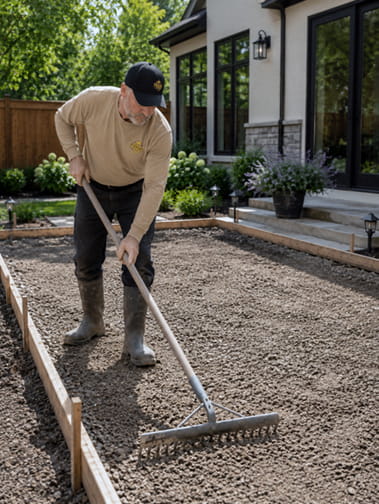
Concrete contractor grading and compacting the base before pouring a backyard concrete patio.
Backyard Concrete Patios Built with Proper Prep
Many patio issues start with the ground beneath the concrete rather than the concrete itself. So before we schedule a pour, we walk the yard, figure out how we're getting material and equipment back there, and verify that the underlying soil is adequately prepared to support the slab.
Site access. Getting concrete into a backyard is half the job. Sometimes the truck can chute it over a fence, and sometimes we're wheeling it back one buggy load at a time. That changes the labor and the price, so we figure it out up front.
Layout and forms. We set the forms so the patio ends up the size and shape you asked for, square where it should be square, and lined up with the house instead of drifting off at an angle.
Grading and drainage. A patio should fall about a quarter inch per foot away from the house. That little bit of slope is what keeps rainwater running off the slab instead of pooling on it or heading toward your foundation.
Base preparation. We dig out the soft soil and compact a gravel base under the slab. Concrete doesn't bend — if the ground under it settles, the slab cracks — so the base gets as much attention as the pour itself.
Reinforcement when needed. Depending on the size of the slab and the soil it's sitting on, we'll add wire mesh or rebar. Not every patio needs it, but when it does, it's the difference between hairline cracks staying hairline and a slab breaking apart over time.
Clean pour and finish. On pour day we place it, screed it, and finish it — usually a broom finish so it's not slippery when wet. We also cut control joints, because all concrete cracks eventually, and joints make it crack in a straight line where we planned for it instead of wandering across the middle of your patio.
Concrete Patio Projects We Handle
Most of the patio calls we get fall into one of these buckets. If yours is close to one of them, there's a good chance it's a fit.
Backyard Patios
A straightforward slab for a table, some chairs, and a grill — the space most backyards are missing. Most residential patios get poured about 4 inches thick over a compacted base.
Patio Extensions
If your current patio is too small, we can form up against it and pour an addition. We match the height so there's no lip to trip on, and put a joint where old meets new, since the two slabs will move a little differently over time.
Side-Yard Concrete Slabs
Side yards are usually wasted space that turns to mud every winter. A slab back there gives you somewhere clean for trash cans, storage, or just a solid path around the house.
Small Concrete Pads
Sheds, AC units, generators — anything heavy sitting on bare dirt eventually settles and leans. A small pad keeps equipment level and up off the ground.
Walkway-to-Patio Connections
A walkway that ties the patio to the back door or the side gate, so you're not crossing wet grass to get to it half the year.
Utility Pads
Hot tubs are the big one here. A filled hot tub with people in it can weigh a couple of tons, so the pad gets poured thicker and reinforced. We size it for what's sitting on it, not just what fits.
Outdoor Living Area Slabs
A larger slab poured with a future pergola or outdoor kitchen in mind. Where things will sit — and where power needs to come up — gets decided before the pour, not after.
One note: this page covers standard gray concrete. We do stamped and decorative work too — there's more on that in the FAQ below, or just ask when you call.
Plan Utilities Before the Patio Goes In
Lighting, outlets, a pergola, an outdoor kitchen, a hot tub — you don't have to be ready to build any of it yet. But if there's a chance you'll want it someday, the time to run conduit is while the ground is still open. It gets buried in the trench before the pour, capped off, and just sits there waiting until you're ready to use it.
Adding electrical after the patio is finished is a different story. At that point your options are saw-cutting the slab you just paid for, or running exposed conduit along walls and fences — and those runs need something solid to attach to the whole way over, which isn't always there between the panel and where the power needs to end up. Both options work, but neither one looks good, and both cost more than a length of empty conduit would have on pour day.
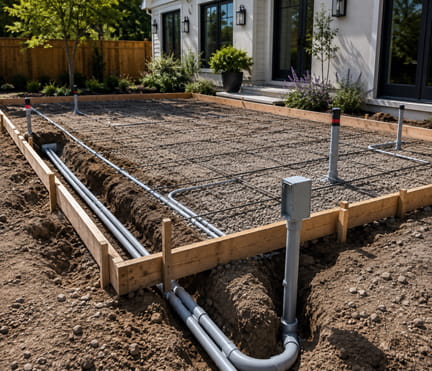
Electrical conduit installed before the concrete patio is poured
Project Example: Underground Electrical Conduit Before a Patio Pour
On this backyard patio job up in the Oakland Hills in Oakland, CA, we brought in Matt from East Bay Electrician Services — an Oakland electrician we've used on job after job because his work is clean and it passes inspection. Before any concrete went down, trenches were dug through the patio area and Matt ran Schedule 80 PVC conduit underground, with the wiring protected inside it. The Schedule 80 PVC conduit would remain permanently protected beneath the concrete patio after the pour, providing a clean underground path for the electrical wiring. Where the connection needed to surface, the conduit came up out of the ground, transitioned to EMT, and ended at an outdoor electrical box right where the power was needed.
- A cleaner finished patio
- No overhead conduit strung through the yard
- Nothing bolted across walls or fences
Pre-planning is important. The trenching, the conduit, and the pour all had to be scheduled in the right order — and because they were, nothing had to be torn up or redone afterward.
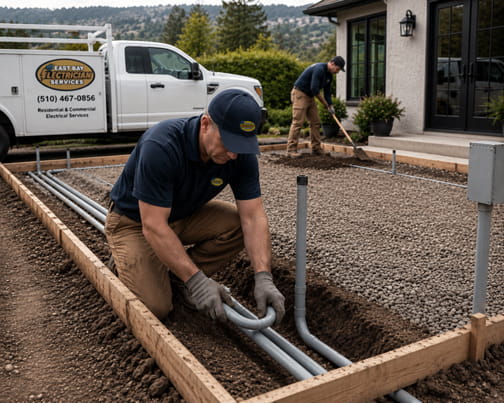
Underground electrical conduit installed before the concrete patio is poured
Concrete Patio FAQs
Need a Concrete Patio?
Give Pavers For Driveways a call at (925) 655-9261 and tell us what you're thinking — patio, extension, side-yard slab, whatever it is. We'll ask a few questions about the yard and the access, and let you know straight up whether it's a project we can take on.